


By Dr. ARSHAVIR GUNDJIAN, C.M.
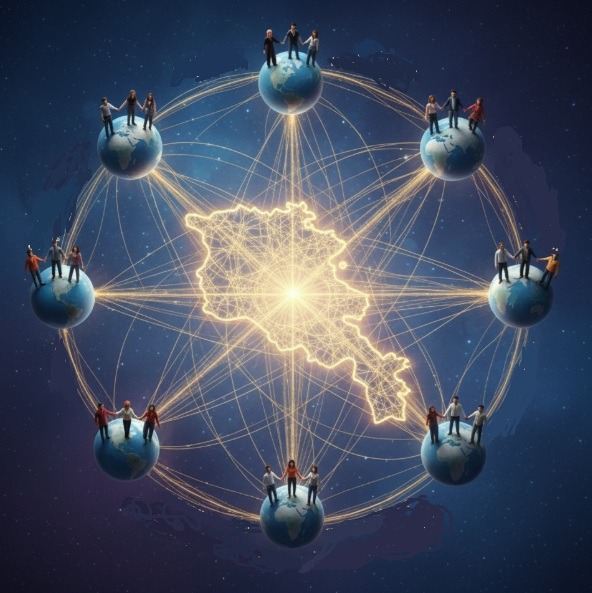
This article emphasizes that the Armenian diaspora is an integral part of the Armenian nation. As such, it must at the very least officially participate in the upcoming national elections in Armenia with observers.
Pan-Armenian Responsibility
The next elections of the National Assembly of Armenia will take place on June 7 and electoral campaigning already seems ever-present in Armenian life.
These elections, which will determine the political leadership of Armenia, including, in particular, its prime minister, are of an exceptionally fateful and determinative nature, given the current unprecedented national and international complex and confusing political situation. The fate and character of not only Armenia but our entire nation for many years to come hang in the balance.
Consequently, today the Armenian people as a whole – first and foremost the citizens of Armenia, but also the vast diaspora – are obliged to consider themselves facing a great responsibility, to influence the outcome of these elections with all their abilities, by all means available to them, guided primarily by national supreme interests.
The Role of the Armenian Press
Ahead of the elections, it is expected that the Armenian press will focus increasingly every day through analyses and coverage to direct the attention of Armenian society to the urgent issues raised by the elections.
The list of serious issues raised internally by various domestic political groups is already very large. However, the goal of this article goes beyond this to remind readers of the existence of the vast Armenian diaspora, which has been completely forgotten in the general hullabaloo.
The Great Importance of Armenia-Diaspora Interconnection
The mutual obligations and rights of the Armenian diaspora and the Republic of Armenia towards each other are among the fundamental issues at stake. Unfortunately, since the Armenian Genocide, in other words during the past 111 years, notwithstanding isolated temporary initiatives, this topic has never become the subject of a thorough and profound discussion, analysis and ultimately actionable conclusion in a pan-Armenian manner.
What is even more worrying is the not only openly lukewarm, but downright contemptuous attitude adopted by the current authorities of Armenia towards the diaspora. That is why the author of these lines, raises the issue of defining the mutual obligations and rights of diaspora and Armenia clearly as a subject worthy of serious national discussion in the run-up to the elections in Armenia.
The Role of the Diaspora Concerning the Shaping of the Armenian Government
Starting with this article and with other discussions that may likely follow, the role and indisputable stake of the diaspora in the elections to be held in Armenia, regardless of changing authorities and the whims or goodwill of the prime ministers or leaders of the day, will be clarified.
It is also certain that in the course of discussing this fundamental issue, in the absence of a supervisory structure recognized by the state and nation as a whole, the application of the principle of free expression of opinions will lead to the statement of diverse and often contradictory opinions. As for the author of these lines, in accordance with his already consistently established habit, he affirms that his discussion is based, to the greatest extent possible, within the framework of historical and practical indisputable data, especially on logical and difficult to dispute reasoning.
The most important point that forms the basis of all our other reasoned conclusions is that the Armenian diaspora is an inseparable part of the Armenian nation.
The Specificity of the Armenian Diaspora
It is a well-known fact that many other nations also have members who have left their motherland of their own free will and settled in different parts of the world. Consequently, all these nations have small or sometimes more populous diasporas. However, such people cannot and actually do not have the pretension to consider themselves part of their ancestral nation. At most, they say that they simply belong to a certain nationality by origin.
The situation is fundamentally different for the millions of Armenians who make up the large Armenian diaspora. Their number, first of all, exceeds by many times the number of Armenians living within the borders of mother Armenia itself. Also it is as the result of a brutal and inhuman crime that they were deported, leaving their parental homes, work, schools, and institutions to escape certain death, and they settled initially temporarily in different countries of the world. This group of millions of Armenians, who bore the qualification of the Armenian diaspora, is beyond doubt, at that tragic juncture, and from the very first days, an indisputably inseparable and large part of the Armenian nation.
The Path of the Post-Genocide Diaspora
In order to logically develop our thoughts, let us now follow step by step the successive stages that the collectivity called the diaspora has gone through over the course of 111 years, from the time of the Armenian Genocide to the present day.
Although abstract, if for a moment, as a simple mental exercise, we continue our chain of logic and assume that in those hellish days of the Genocide, an Armenian statehood that justified its name had existed, the authorities and leaders of that day, conscious of their responsibility, would have considered it their primary and immediate duty to undertake the huge work of bringing together and defending in a number of different ways that one large segment of the Armenian nation.
However, we well know that in those days there simply was no such statehood with such abilities.
Having narrowly escaped complete annihilation, the Soviet Armenia of those days which itself experienced quite difficult conditions, and then had to go through the grueling years of World War II, after three decades, was barely able to take the first few, completely imperfect, painful steps to gather its children from the diaspora, which was theoretically its responsibility, by implementing the largely unsuccessful “Nerkaght” repatriation program.
It is not our goal, and it is naturally not possible in this article to further expand on the practically insignificant capacity of the successive regimes of the Republic of Armenia to provide national care to the Armenian diaspora, even after those days, up to our own time. However, it is safe to say that the sum total of the capacity of that work can be generally – unfortunately – accurately qualified with these two words: almost nothing.
In order to prevent any hasty superficial criticism that might be expected in relation to this weighty statement, I must add that the author of these lines is very familiar, through direct personal and very long experience, with all the details of the 1946 repatriation movement, and later with its continuation to a lesser extent in the 1960s. He is also very familiar with certain praiseworthy efforts of the Committee for Cultural Relations with the Armenian Diaspora in those years and later, as well as with the details of the implementation of various summer programs specifically for diaspora Armenian teachers and youth. He is familiar with the extent of the even more appreciable work of the Ministry of Diaspora, which was created in a short period of time during the years of independent Armenia. Finally, he is familiar with the unfortunate halting by the current authorities of the fairly successful initiative of the Ministry of Diaspora, and its replacement with a so-called Diaspora Commissioner, which is completely fruitless and deserving of serious criticism.
Insufficient State Care
The central purpose of this article is, perhaps for the first time, to state openly and loudly that it is unfortunately clear that the total sum of all the above-mentioned works initiated by the Republic of Armenia authorities at all times, could not satisfy in any way the enormous needs and demands of the worldwide Armenian Diaspora. However, it was undeniably its duty to satisfy these needs during the past 111 years so that this vast community, which had great potential and capacity, would be able to at least maintain its albeit imperfect but respectable national character to this day.
Today we emphasize that instead, all of this was accomplished in a wonderful way by that very same unprotected collectivity called the Armenian diaspora, through individual sacrifices and often completely voluntary work worth millions of dollars.
The objectively indisputable consequence of this reality is that the Armenian state of the past and the present and also the foreseeable near future, and all the authorities representing it, are all, morally, directly, and indisputably indebted to all those in the diaspora who in their place have provided that national care.
These latter include all the various selfless charitable, educational, cultural and political organizations that have been created over the years with countless sacrifices and that are still operating today, as well as independent individuals. In these organizations, there are lawyers, scientists, and businessmen who have achieved great success in their careers. They could easily devote their precious time to pleasure or to many highly profitable activities, but they have served and still serve the Armenian nation in a completely voluntary manner through a self-imposed consciousness of national duty.
The Difference Between a Salaried Official and a Dedicated Volunteer
At this point, it is pertinent to draw the attention of the Armenian authorities to the fact that the same work that they carry out in Armenia more or less successfully, with the large bonuses they receive from various state funds, is generally carried out pro-bono by Armenians in the diaspora completely without any pecuniary compensation. Moreover, the latter even donate a portion of their personal wealth towards the implementation of various educational, cultural, charitable and community-benefiting works.
We would like to point out that all of this has been done in the diaspora for 111 long years with great difficulty and yet with tangible success, solely in order to preserve the national Armenian identity of the great collectivity in the diaspora.
Yes, the diaspora itself is the one that completely takes over the enormous responsibility that is undoubtedly the duty of the Armenian authorities, but which has been absent presumably due to their incapacity.
The Diaspora is a Source of Strategic Wealth for Armenia
At this point, is it necessary to also remind the Armenian authorities that the responsive part of the Armenian diaspora is directly an objective source of great wealth for Armenia, provided, of course, that the authorities of the day have the actual ability and awareness to make use of that wealth constructively? Perhaps here it should be recalled that very often, especially in the recent past, public statements were made in Armenia with great pride that “If Azerbaijan is rich in its oil, Armenia is even richer in its diaspora.”
Naturally, just as the usefulness of Azerbaijani oil is revealed only when it is extracted from under the earth, so too would the usefulness of the Armenian diaspora be revealed, especially when the authorities of Armenia realize their duty, make efforts and show their care, and in organized ways bring worthy diasporan Armenians closer to the homeland, instead of rejecting and pushing them away.
Conclusion
Finally, based on the reasoned objective data provided in this article, we now reach the immediate and main goal of the present writing and, in anticipation of the upcoming elections to the National Assembly of Armenia, we address our words to the current authorities of Armenia.
The global Armenian diaspora, representing many millions, is not just theoretically but objectively an inseparable part of the Armenian nation. Therefore, as the only internationally recognized legitimate authority of the Armenian nation, you are certainly indebted to it, and you are also obliged to accept it with affection in its very nature as an inseparable part of the Armenian nation.
Therefore, the Armenian authorities are also naturally obliged to create the opportunity and the specific official method for diasporan Armenian representatives to participate in the upcoming elections to the National Assembly.
Once again, in order to prevent the expected immediate and easy objections as to how the diaspora, which does not have a common organizational structure, will appoint its representatives, we practically and logically point out that it is first the turn of the Armenian authorities.
Our demand is that, taking into account the fundamental logical reasoning presented so far in this article, the Armenian authorities first of all officially accept the principle of diasporan participation in the elections. Only after that will it be the duty of the various responsible circles of the diaspora to find a method that is as satisfactory as possible for the general public to appoint its representatives.
Until then, and for now, once again taking into account the expected complex legislative obstacles to civic affiliation, we propose as an indisputable immediately feasible option that the abovementioned representatives of the diaspora be officially granted the status of observers supervising the upcoming elections.
The main and immediately applicable conclusion is that when various European or other official observer representatives are invited to be present at the elections in Armenia, it is beyond a doubt that the Armenian diaspora, which is an integral part of the Armenian nation, should also have the priority right, at least perhaps this time, to be present and thus officially participate in those elections as “official observers.”
The Armenian Mirror-Spectator